Home / Products / Marine compressors

WFC Marine Starting-Air Compressor Range

One frame and one valve set in three cylinder counts — ZFC single 14.5–22, VFC twin 30–44, WFC-90 three-cylinder 60–120 m³/h, all at 3.0 MPa, from workboats to FSRUs.

WFC Marine Starting-Air Compressor Range
Marine · single / twin / three-cylinder · 3.0 MPa starting air

WFC Marine Starting-Air Compressor Range

One frame and one valve set in three cylinder counts — ZFC single 14.5–22, VFC twin 30–44, WFC-90 three-cylinder 60–120 m³/h, all at 3.0 MPa, from workboats to FSRUs.

Overview

Starting air is the most reliability-critical circuit on board: 30 bar class, charged intermittently rather than supplied continuously. At that pressure a piston machine beats a screw — single-stage compression is enough, the design is simple, and the crew can repair it on board.

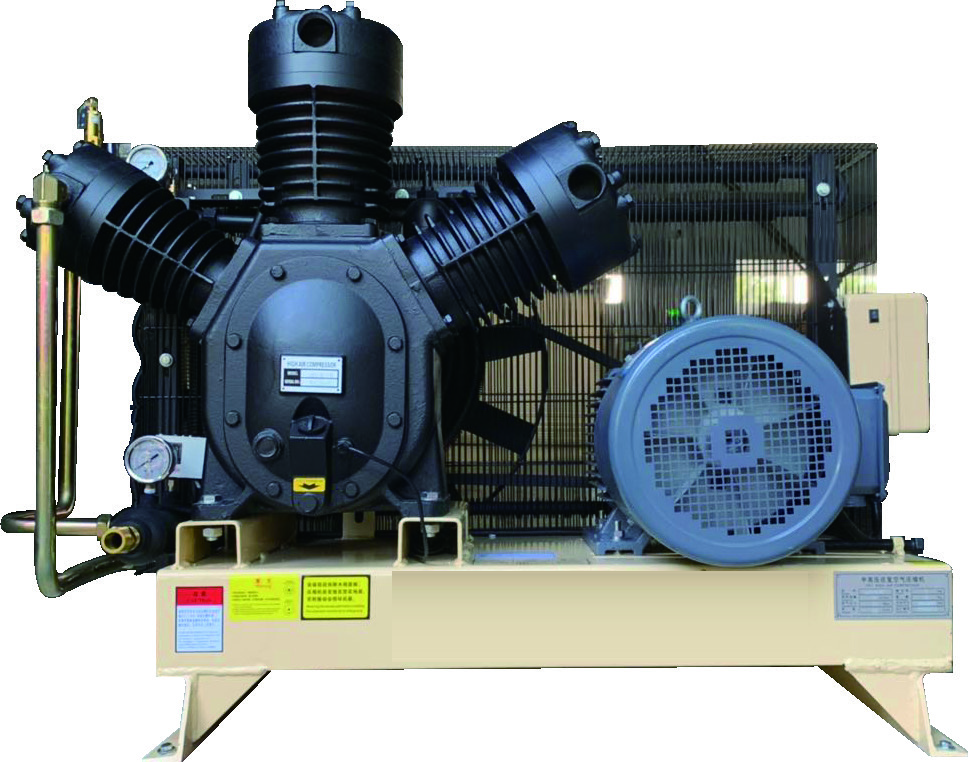
Cylinder count sets the capacity. ZFC single-cylinder 14.5–22 m³/h suits small vessels and workboats; VFC twin 30–44 m³/h covers medium cargo and container ships; WFC-90 three-cylinder 60–120 m³/h serves large vessels, FSRUs and one-running-one-standby arrangements. All three share the same valves and safety parts, so spares are common.

Key features

High-pressure intermittent

3.0 MPa output built for intermittent bottle charging.

Three capacities

14.5–22 (single), 30–44 (twin), 60–120 m³/h (three-cylinder).

Air cooled

No cooling-water circuit, so the package fits tight engine rooms.

Repairable on board

Single stage, simple build, routine work without yard support.

Technical notes

A starting-air bottle needs a quick fill, not a continuous supply. At 3 MPa a piston machine is the right tool: one stage is enough, the construction is simple, and the crew can service it.

Choosing the cylinder count: look at bottle volume and the charging time you can accept. Small bottles, single cylinder. Bigger main engine and bigger bottles, twin. Large vessels and FSRUs with big bottle banks need the three-cylinder to fill within one manoeuvring period. More cylinders add weight, but the twin and three-cylinder machines offset crank phases, so reciprocating forces partly cancel and they run smoother than the single.

3 MPa is starting-air pressure only. Do not use it as a general-purpose source — reducing it wastes the work. For workshop air use the GRF screw range.

When to choose it

Suits
  • Main and auxiliary starting air at 3.0 MPa
  • Small vessels and workboats (single)
  • Medium cargo and container ships (twin)
  • Large vessels and FSRUs (three-cylinder)
  • One running, one standby
  • Where the crew services the machine
Choose something else
  • 7–12 bar general air — use the GRF screw range
  • Continuous duty rather than bottle charging
  • Oil-free Class 0 air — use GRF PET or an oil-free model

Model data

Models in this family

ModelCylindersCapacityPressure (MPa)Motor (kW)CoolingSpeed (r/min)Weight (kg)L×W×H (mm)
ZFC-33#single0.2423.04Air15002431215×520×637
ZFC-33#single0.3673.05.5Air15002651215×520×637
VFC-43#twin0.53.07.5Air15003251215×520×637
VFC-43#twin0.7333.011Air15004501500×800×1100
WFC-90three-cylinder1.03.015Air14604501500×800×1100
WFC-90three-cylinder1.63.018.5Air14606001600×900×1100
WFC-90three-cylinder2.03.022Air14606501600×900×1100
Full data for this product is confirmed in the order technical agreement — contact us for the sheet.

Related products

Related products

All products

← Back to products

Intelligent control

Sequencing, protection and logging in the panel

Control logic does not depend on an external platform or cloud service. Multi-unit sequencing, scheduled changeover, fault lockout and run logging all execute inside the control panel; communication ports are disabled and physically sealed at the factory and are enabled only when an interface is required.

Multi-unit sequencing

Units in the same air station are staged in bands by pressure: one machine acts as master and coordinates the group, the others load on demand. The unit with the lowest accumulated running hours starts first, so no single machine runs fully loaded while the rest stay idle.

Automatic load / unload

At the unload pressure the inlet valve closes and the blow-off valve opens; when pressure falls back to the load pressure the inlet reopens. If the unit runs unloaded beyond the set time it stops automatically, which avoids ineffective running hours.

Limit protection and reset lockout

Overload, phase loss, phase imbalance, voltage abnormality, high discharge temperature, high supply pressure, wrong phase sequence, low cooling water and sensor break are all monitored; any one of them trips the main circuit and locks the unit out. A manual reset is required before restart.

Consumable timing and dP criteria

Air filter, oil filter and separator are timed by running hours and monitored by differential pressure; lubricating oil and grease are timed separately. The panel indicates when an interval is due, and the maintenance interval is taken from the instrument records.

Run records and fault storage

Total running hours and total loaded hours are accumulated; the fault history is retained on power loss. On power-up the controller checks I/O, clock, A/D channels, communication ports and memory, and raises an alarm before entering run mode if a check fails.

Scheduled pressure and start/stop

Pressure setpoints can be switched by shift; outside production hours the unit goes to low-pressure standby or stops. Holiday periods can be set as a block, so no daily manual change of parameters is needed.

Unit 1Unit 2Unit 3
Control panelLoad/unload · Protection · Sequencing
DCS / host systemRS-485 · Modbus RTU
The master coordinates the group and the followers are rotated by accumulated running hours. Status and fault words are uploaded over one RS-485 link, with no additional gateway.

Communication: two RS-485 ports, Modbus RTU slave

One port is used for PID speed control of the panel-mounted VSD, the other for multi-unit sequencing or connection to a host system. Supply pressure, discharge temperature, running and loaded hours, load/unload status, fault words and start/stop commands are all standard registers; the register list is supplied with the unit.

  • 40001Supply pressure
  • 40002Discharge temp.
  • 40003Total run hours
  • 40009Fault / warning word

Cybersecurity: disabled at the factory by default

Marine models are configured to the relevant requirements of the China Classification Society Guidelines for Ship Cyber Security (GD027-2025):

  • No external data interface is brought out of the panel, there is no wireless module, and the unit is not connected to the ship's network.
  • No general-purpose operating system, no file system and no general network stack; the firmware runs directly on the microcontroller.
  • Unused ports are disabled in logic and physically sealed: insulating plugs, protective covers and tamper-evident seals, each individually marked.
  • Multi-level password authorisation; parameters cannot be changed without authentication. User-level parameters are locked before shipment.
  • Remote update and remote configuration are not supported; there is no USB or other external storage interface in the panel.

Send us the duty point — we reply with a sized proposal

Flow, pressure, cooling water, power supply, class society and delivery port: six items are enough.

Online SelectorRequest a Quote